
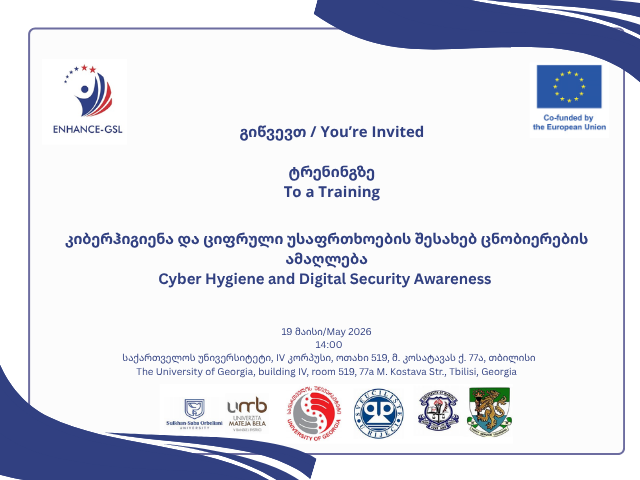
The University of Georgia Invites You to a Training Session
Cyber Hygiene and Digital Security Awareness
Programme
Chapter 1 — Introduction
1.1. What Is Cyber Hygiene and Why Is It Important?
1.2. Overview of Cyber Threats: Real-Life Cases from Georgia
1.3. Training Structure and Objectives
Chapter 2 — Personal Computer Security
2.1. Updating the Operating System and Software
2.2. Antivirus Software and Endpoint Protection
2.3. Risks Associated with USB Drives and External Devices
2.4. Software Licensing and the Risks of Unlicensed Software
Chapter 3 — Passwords and Authentication
3.1. Principles of Strong Passwords: Length, Complexity, and Uniqueness
3.2. Password Managers: Uses and Benefits
3.3. Multi-Factor Authentication (MFA/2FA): Types and Setup
Chapter 4 — Email Security
4.1. Phishing: How to Recognise It and Its Types (Spear Phishing, Whaling)
4.2. Malicious Attachments and Links: What to Check
Chapter 5 — Internet Safety
5.1. HTTPS: The Importance of Encrypted Connections
5.2. VPNs: Uses and Limitations
5.3. Risks of Public Wi-Fi and Man-in-the-Middle Attacks
5.4. Browser Security: Extensions, Cookies, and Browsing History
5.5. Assessing the Trustworthiness of Websites
Chapter 6 — Social Media Security
6.1. Configuring Privacy Settings
6.2. OSINT: What Information We Leave on Social Networks
6.3. Social Engineering: Manipulation and Pretexting
6.4. Fake Profiles and Impersonation
Chapter 7 — Mobile Device Security
7.1. PINs, Facial Recognition, and Fingerprints
7.2. App Permissions: Granting Only Necessary Access
7.3. Lost or Stolen Devices: The Remote Wipe Procedure
Chapter 8 — Data Security
8.1. Data Encryption: Encryption at Rest and in Transit
Chapter 9 — Workplace Security
9.1. Clean Desk Policy: Physical Security in the Workplace
9.2. Shoulder Surfing: Screen Privacy in Public Spaces
9.3. Visitor Management and Physical Access Control
9.4. Specific Risks of Remote Work
Chapter 10 — Disinformation, Misinformation, and False Information
10.1. Definitions: Disinformation vs. Misinformation vs. Malinformation
10.2. Deepfakes: Recognising Manipulated Videos, Audio, and Images
10.3. Fact-Checking Tools
10.4. Influence Operations and Social Manipulation
10.5. Critical Thinking in the Digital Space
Moderator: Giorgi Pirveli
Date: 19 May, 14:00
Venue: The University of Georgia, building IV, room 519, 77a M. Kostava Str., Tbilisi, Georgia